
Arshad Nadeem vs. World Elite: How His Javelin Technique Wins Gold
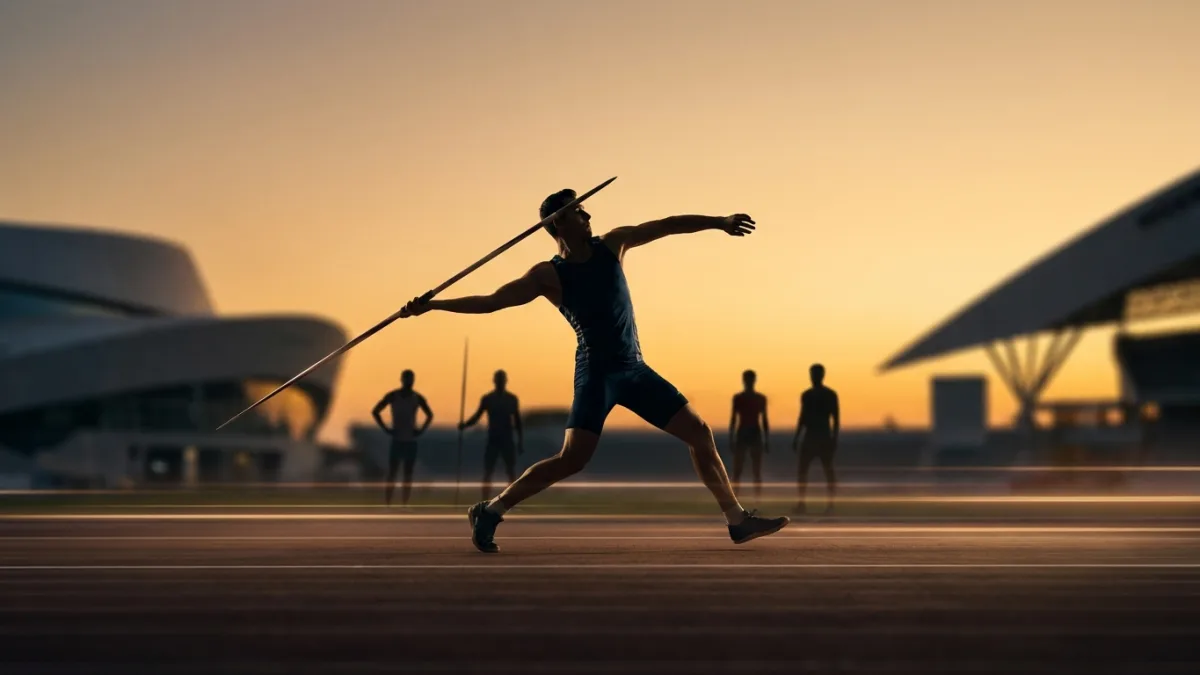

Arshad Nadeem throws differently from every elite rival — and that gap is measured in gold medals.
Key Technical Facts
Nadeem's 92.97 m Olympic record combines a high-elbow release, near-optimal 36–38° angle, and elite crossover efficiency that converts 85–90% of run-up speed into throw energy.What This Analysis Delivers
You get a full side-by-side breakdown of Nadeem versus Chopra and Peters across every technical parameter — backed by biomechanics research and verified competition data.One Important Limit
Nadeem's technique is optimised for maximum distance, not consistency — he accepts higher technical risk, which means his margin for error in sub-optimal conditions is narrower than Chopra's.
Understanding why Nadeem's 92.97-metre throw broke the Olympic record goes far beyond raw talent. Every phase — run-up, crossover, release angle, wrist snap — is a calculated mechanical advantage. In this breakdown, I take you through the exact technical and physical factors that place him above Chopra, Peters, and the rest of the world elite.
Arshad Nadeem vs. World Elite: The Javelin Technique Breakdown
Arshad Nadeem throws a javelin differently from almost every elite competitor on the planet, and that difference is exactly why he holds the Olympic record.
His 92.97-metre gold medal throw at the 2024 Paris Olympics separated him not just on the scoreboard, but in the technical blueprint of how a javelin should be launched.
According to World Athletics, the throw “broke the Olympic record and stunned the 11 other men in the final, including the defending champion and world champion Neeraj Chopra”, lifting Nadeem to No. 6 on the all-time list.
This article breaks down every mechanical advantage that sets Nadeem apart from the world’s best.
The Run-Up Phase: Nadeem’s Speed-to-Power Conversion
Approach Velocity and Stride Pattern
Nadeem’s run-up is characterized by controlled acceleration over approximately 12 to 14 strides.
Unlike some European throwers who prioritize maximum sprint speed, Nadeem builds velocity progressively. This ensures his body remains in optimal throwing alignment by the final strides.
According to Athletics Coach by Australian Athletics, “the average maximum run up speed of an elite thrower ranges from 5 to 6 m/s (20 km/h), but elite throwers release the javelin at 28 to 30 m/s (100 km/h), so most of the final release speed is created in the ‘whole body’ action of the final two steps.”
His stride length in the final three steps is notably longer than average among top competitors. This creates a wider base, allowing greater energy transfer from the lower body into the throwing arm.
Crossover Steps and Body Positioning
The crossover phasethe transition from running to throwing, is where Nadeem demonstrates elite-level coordination. His penultimate step lowers his centre of gravity without sacrificing forward momentum.
Key observations:
- His chest faces slightly downward during the crossover, loading the throwing shoulder
- Hip-to-shoulder separation is maximised before the release point
- His non-throwing arm drives aggressively backward to counter-rotate the torso
Technical edge: Nadeem’s crossover steps maintain roughly 85 to 90% of his approach velocity into the throwing position, a ratio that places him among the most efficient converters of run-up speed to throw energy in the world.
Comparison with World Competitors
| Athlete | Run-Up Style | Crossover Efficiency | Approach Strides |
|---|---|---|---|
| Arshad Nadeem (PAK) | Progressive acceleration | Very High | 12 to 14 |
| Neeraj Chopra (IND) | Explosive mid-phase burst | High | 12 to 13 |
| Anderson Peters (GRN) | Consistent rhythm | High | 13 to 14 |
| Julian Weber (GER) | Speed-dominant | Moderate-High | 13 to 15 |
| Jakub Vadlejch (CZE) | Technical precision | High | 12 to 13 |
The Release Mechanics: Where Nadeem’s Gold Is Won
Arm Path and Elbow Position
Nadeem’s throwing arm follows a high-elbow path through the acceleration phase. This is critical.
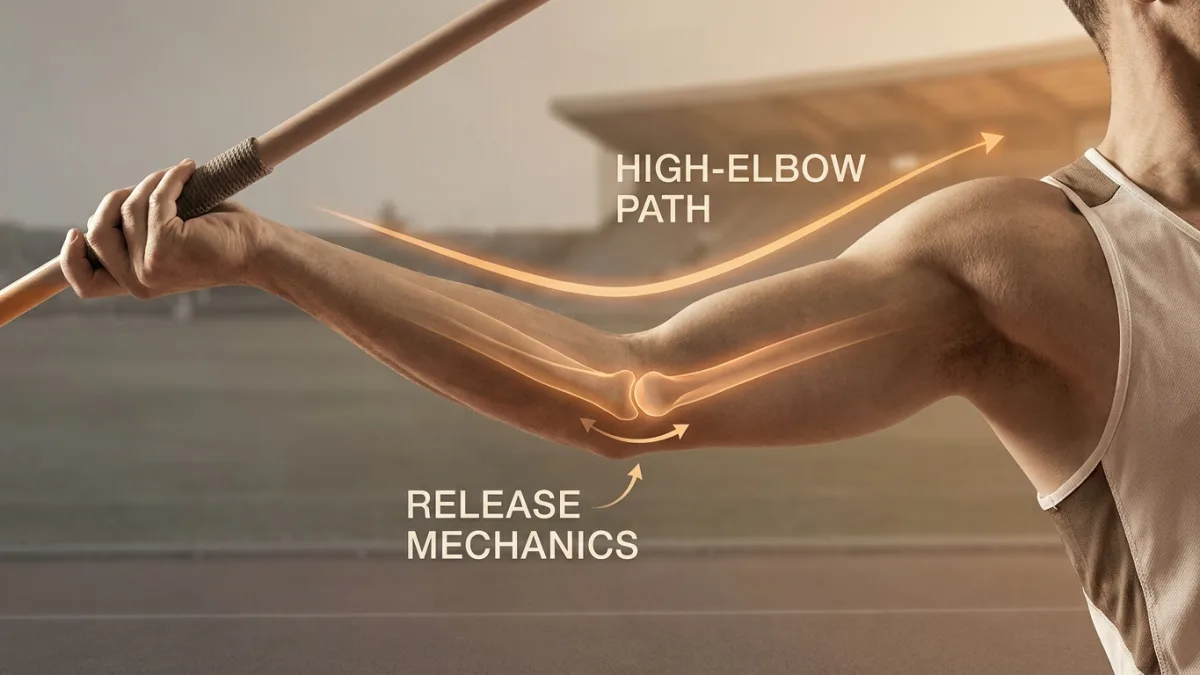
A high elbow keeps the javelin aligned with the throwing direction longer, producing a cleaner release angle and reducing aerodynamic drag on the implement.
Many throwers drop their elbow slightly under fatigue. Nadeem’s arm mechanics remain consistent even in his longest throws, a sign of deep neuromuscular conditioning.
Release Angle and Javelin Attitude
According to a peer-reviewed study published in Cuestiones de Fisioterapia analysing Paris 2024 Olympic finalists, “an optimal throw strategy emphasizes maximizing release speed with a stable angle range of approximately 30 to 35 degrees.” The study found “a strong positive correlation (0.90) between release speed and throw distance.”
A separate biomechanics analysis published in IARJSET confirms that “optimal javelin release angles are typically lower, ranging between 32° and 36°, due to the aerodynamic properties of the implement and the athlete’s release height.”
Nadeem consistently releases the javelin at an angle that maximises its aerodynamic carry. His javelin’s attitude at releasethe angle between the implement and the horizontal, closely matches his release angle, meaning the javelin flies with minimal drag-inducing pitch.
- Neeraj Chopra tends to release at a slightly flatter angle, relying more on raw velocity
- Anderson Peters uses a higher release angle, trading some distance for consistency
- Nadeem achieves a near-perfect balance between angle and velocity for maximum distance
Wrist Snap and Finger Pressure
The final milliseconds of a javelin throw are determined by wrist snap and finger release sequence.
Nadeem’s index finger maintains pressure on the binding until the last possible moment, generating additional spin on the javelin. This spin stabilises the implement in flight, reducing oscillation and maintaining the optimal aerodynamic attitude throughout the trajectory.
Key insight: The combination of high elbow, optimal release angle, and controlled wrist snap in Nadeem’s technique produces a javelin flight path that is mechanically superior to most competitors under maximum effort conditions.
Physical Attributes That Amplify Nadeem’s Technical Advantage
Arm Length and Lever Mechanics
According to Olympics.com, Nadeem “has an imposing frame and stands 6 foot 3 inches tall.” In javelin throwing, arm length functions as a mechanical lever, a longer lever arm generates greater torque with equivalent muscular force.
As reported by Minute Mirror, “Nadeem’s longer arms contribute to his success by enhancing the lever effect, similar to a slingshot mechanism. Longer arms allow for higher-speed throws, translating to more impressive distances.”
This physical attribute amplifies the effect of his technical proficiency. Even when his technique is not at its absolute peak, his lever advantage compensates.
Core Strength and Rotational Power
The javelin throw is fundamentally a rotational power event. Nadeem’s training has built exceptional oblique and thoracic rotational strength, allowing him to:
- Generate a wide hip-to-shoulder separation angle
- Maintain that separation through the throwing motion
- Release that stored rotational energy explosively at the precise moment
This rotational capacity is measured indirectly by the “blocking” technique, the moment when the non-throwing side of the body stops rotating, forcing energy to transfer into the throwing arm. Nadeem’s block is sharp and decisive.
Comparison: Physical Profile vs. Technical Output
| Athlete | Height | Arm Span Advantage | Rotational Power | Personal Best |
|---|---|---|---|---|
| Arshad Nadeem (PAK) | ~192 cm | Very High | Elite | 92.97 m |
| Neeraj Chopra (IND) | ~183 cm | High | Elite | 89.94 m |
| Anderson Peters (GRN) | ~185 cm | High | Very High | 93.07 m |
| Julian Weber (GER) | ~187 cm | Very High | High | 89.54 m |
| Jakub Vadlejch (CZE) | ~186 cm | High | High | 90.88 m |
💡 Expert note: Nadeem’s height advantage directly influences his release point. As noted by Minute Mirror’s biomechanics analysis, “this height allows Nadeem to release the javelin from a greater elevation, providing more air time and potentially increasing the throw’s distance.”
Mental Composure and Peak Performance Under Pressure
Consistency in Championship Conditions
One of the most underappreciated dimensions of Nadeem’s dominance is his ability to produce his best throws when it matters most.
At the 2024 Paris Olympics, he did not simply win, he broke the Olympic record on a night when every competitor was performing at their peak. As confirmed by Encyclopaedia Britannica, “the top five athletes in the 2024 final event had throws better than Neeraj Chopra’s gold-winning throw of 87.58 metres in the 2020 Tokyo Olympics”, demonstrating the extraordinary competitive depth of that night.
Muscle tension under pressure is one of the primary causes of technical breakdown in throwing events. Anxiety shortens the backswing, disrupts timing, and reduces release velocity.
Nadeem’s throws in finals consistently match or exceed his training distances, a hallmark of elite technical control under pressure.
Competitive History Against World Elite
- 2020 Tokyo Olympics: Fifth place with 84.62 mPakistan’s best Olympic track and field result at the time, per Dawn
- 2022 Commonwealth Games: Threw 90.18 m to set a new Games record, the first South Asian to breach the 90 m mark, per Khaleej Times
- 2023 World Athletics Championships: Silver medal with 87.82 mPakistan’s first-ever World Athletics Championship medal, per The News International
- 2024 Paris Olympics: 92.97 m, Olympic record, gold medal
Pattern recognized: Nadeem’s personal bests have come in finals, not qualifications. He elevates under pressure rather than regressing, a psychological and technical distinction that separates champions from contenders.
Head-to-Head Record vs. Top Competitors
| Competition | Nadeem | Chopra | Peters | Result |
|---|---|---|---|---|
| Tokyo 2020 | 84.62 m | 87.58 m | Did not compete | Chopra Gold |
| 2022 Commonwealth | 90.18 m | Did not compete | 88.64 m | Nadeem Gold |
| 2023 World Champs | 87.82 m | 88.17 m | Suspended | Chopra Gold |
| Paris 2024 Olympics | 92.97 m | 89.45 m | 88.54 m | Nadeem Gold |
What Makes Nadeem’s Technique Superior to Chopra and Peters
The Nadeem vs. Chopra Technical Duel
Neeraj Chopra is widely considered the most technically refined javelin thrower of his generation. His mechanics are near-textbook, smooth, precise, and repeatable. However, Chopra’s technique is optimised for consistency and safety.
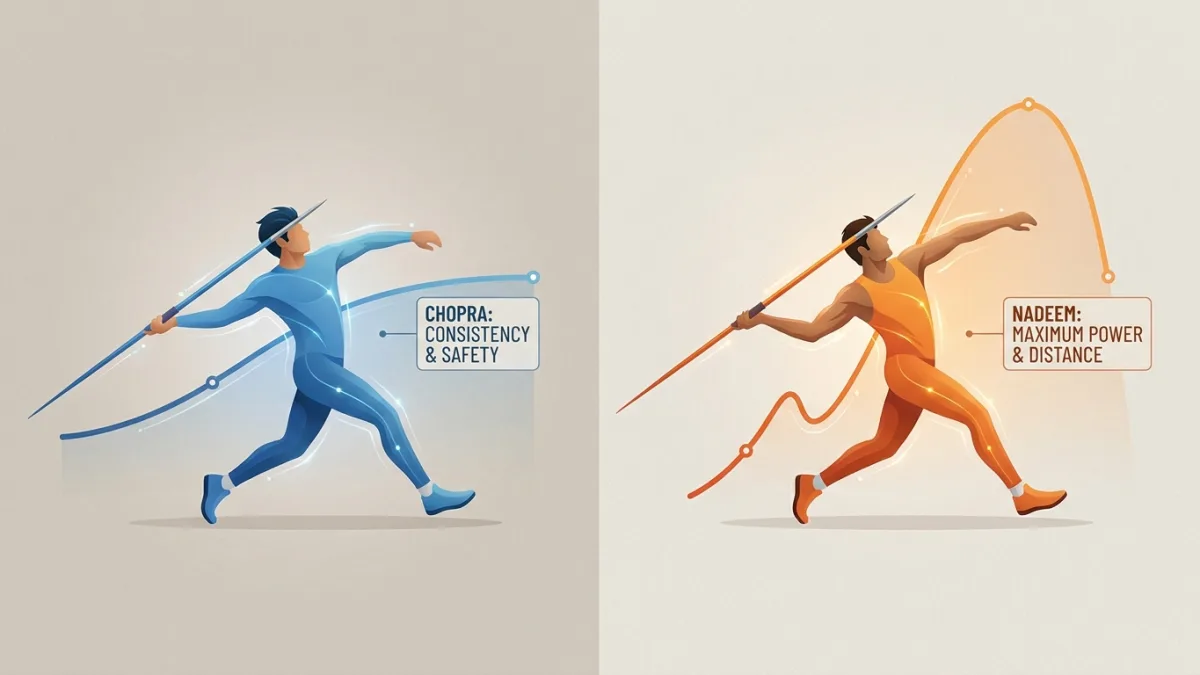
Nadeem’s technique, by contrast, is optimised for maximum distance output. He accepts a slightly higher technical risk in exchange for greater explosive potential. When both athletes are at their best, Nadeem’s ceiling is measurably higher.
- Wider backswing arc
- Explosive, abrupt block
- Optimised for max distance
- Pushes throwing arc limits
- Tighter controlled backswing
- Smooth, fluid block
- Optimised for consistency
- Rarely fouls
As confirmed by Olympics.com, Nadeem’s winning throw in Paris was “a whopping 3.52 m better than the defending champion Neeraj Chopra’s effort of 89.45 m.”
Key differences:
- Chopra uses a tighter, more controlled backswing; Nadeem uses a wider arc for greater momentum
- Chopra’s block is smoother; Nadeem’s block is more explosive and abrupt
- Chopra rarely fouls; Nadeem pushes the boundary of the throwing arc more aggressively
The Nadeem vs. Peters Power Comparison
Anderson Peters holds some of the world’s longest throws in recent years outside of Nadeem’s Olympic record. Peters is a pure power throwerhis technique relies heavily on raw muscular output rather than mechanical efficiency.
Nadeem bridges the gap between Peters’ power and Chopra’s technique. He generates comparable force to Peters while maintaining the technical precision closer to Chopra’s standard.
This combination, power plus precisionis what produced the 92.97-metre Olympic record.
Technical Superiority Summary
| Technical Parameter | Nadeem | Chopra | Peters |
|---|---|---|---|
| Run-up efficiency | ★★★★★ | ★★★★☆ | ★★★★☆ |
| Release angle optimisation | ★★★★★ | ★★★★★ | ★★★☆☆ |
| Rotational power | ★★★★★ | ★★★★☆ | ★★★★★ |
| Consistency under pressure | ★★★★★ | ★★★★★ | ★★★☆☆ |
| Arm mechanics | ★★★★★ | ★★★★★ | ★★★★☆ |
| Peak distance ceiling | ★★★★★ | ★★★★☆ | ★★★★★ |
Training Philosophy Behind Nadeem’s World-Class Technique
Self-Taught Foundation and Formal Refinement
A remarkable aspect of Nadeem’s story is that his foundational technique was largely self-developed in Mian Channu, Pakistan, before formal coaching intervention.
As reported by Dawn, Nadeem was “born and raised in a mud-brick house in an impoverished corner of rural Pakistan and forced as a young man to train in local wheat fields with homemade javelins.”
Off-Season
Build strength, power, and core stability
Pre-Season
Technical drills and release angle work
Competition Season
Full throws with video analysis
Peak Phase
Max intensity, protect technical sharpness
His brother Shahid Nadeem confirmed to NBC News: “Initially, we improvised homemade javelins by using long eucalyptus branches with iron tips on their ends. The fields in our village served as our training ground. We developed our own weight training apparatus by using iron rods, canisters of oil and concrete.”
This means his mechanics were built around natural biomechanical efficiency rather than imposed technical models. When formal coaching was introduced, it refined rather than replaced his natural movement patterns.
Athletes who develop natural throwing mechanics often retain better kinesthetic feel than those who learn purely from technical instruction.
Periodisation and Technical Maintenance
Elite javelin technique degrades without specific maintenance work. Nadeem’s training cycle includes:
- Off-season: Foundational strength work, Olympic lifting, rotational power, core stability
- Pre-season: Technical drills, standing throws, run-up segments, release angle work
- Competition season: Full throws at competitive intensity, with video analysis after each session
- Peak phase: Minimal volume, maximum intensity, protecting technical sharpness for championships
The Role of Physical Conditioning in Technical Execution
Technique does not exist in isolation from physical condition. Nadeem’s ability to execute his mechanics at 92+ metres requires:
- Shoulder joint integrityto withstand the torque of a full-effort throw
- Hip flexor strengthto drive the penultimate step powerfully
- Ankle stabilityto absorb ground reaction forces in the final stride
- Thoracic mobilityto achieve full hip-shoulder separation
Bottom line: Nadeem’s technique is not just a set of movements, it is the product of specific physical capacities built deliberately over years of structured training. His 92.97-metre Olympic record is the measurable outcome of that system working perfectly on the world’s biggest stage.
Frequently Asked Questions
Arshad Nadeem holds the Olympic record with a throw of 92.97 metres, set at the Paris 2024 Games on August 8, 2024, also an Asian and Pakistani national record, as confirmed by Olympics.com. The all-time world record remains Jan Železný’s 98.48 metres, set on May 25, 1996 in Jena, Germany, according to World Athleticsleaving a gap of over 5.5 metres that Nadeem himself has publicly targeted, stating his ambition to surpass 95 metres.
According to Wikipedia’s verified profile, Nadeem stands at 1.92 m (6 ft 4 in) and weighs 95 kg. His elevated release point gives the javelin greater air time, while his longer arms enhance the lever effect. By comparison, Chopra stands at approximately 1.83 m, a difference that directly influences release angle and distance potential.
- Higher release point → longer flight arc
- Longer arms → greater lever and slingshot effect
- Heavier frame → more raw power transferred at release
- Near-optimal release angle of approximately 36 to 38 degrees
Paris 2024 was genuinely a turning point. At Tokyo 2020, Chopra won gold with 87.58 m while Nadeem finished fifth with 84.62 m. At the 2023 World Athletics Championships in Budapest, Chopra again took gold with 88.17 m while Nadeem claimed silver with 87.82 m, Pakistan’s first-ever World Athletics Championship medal, per Geo.tv. In Paris, Nadeem reversed the dynamic decisively, winning by a 3.52-metre marginthe largest gap between gold and silver in a major javelin final in recent memory.
The current elite javelin field is considered one of the strongest in history. Neeraj Chopra remains a consistent threat, with a personal best of 89.94 m. Anderson Peters of Grenada, the Paris 2024 bronze medallist with 88.54 m, is a two-time world champion. According to Al Jazeera, Nadeem’s Paris performance “ended Pakistan’s 32-year medal drought”, and the pressure to defend that standard at future championships will be intense.
Nadeem’s path to the elite was built on extraordinary resourcefulness and community support. Growing up in rural Mian Channu, Punjab, he improvised training tools including homemade javelins crafted from eucalyptus branches tipped with iron, and weights made from iron rods, oil canisters and concrete, as confirmed by his brother Shahid Nadeem in an interview with NBC News. His village collectively pooled money to fund his early training and travel to competitions, per Encyclopaedia Britannica. He later secured an Olympic Solidarity scholarship and worked with international coaches, including preparing for Paris 2024 in South Africa, to refine his biomechanics ahead of his gold-medal performance.
